
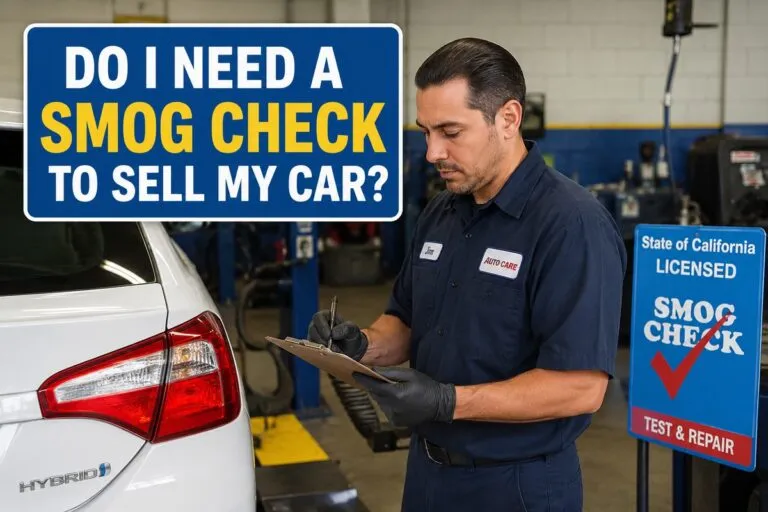
Do I need a smog check to sell my car? If you are selling a used or junk car in Southern California, the answer depends on the vehicle’s age, fuel type, recent smog history, and the type of ownership transfer. In many California private-party vehicle sales, the seller is responsible for providing a valid smog certification before the vehicle changes ownership.
California has specific smog check requirements for vehicle sales, and those requirements can become especially important when you are trying to sell an older car, a high-mileage vehicle, or a junk car that may not pass emissions testing. Understanding when a smog certificate is required can help you avoid delays with the title transfer and determine the best way to sell your vehicle.
Do You Need a Smog Check to Sell a Car in California?
In most cases, yes. California requires a smog check when ownership of a vehicle changes, provided the vehicle is subject to the state’s Smog Check Program.
According to the California Bureau of Automotive Repair, a seller should have the vehicle inspected before selling it and provide the buyer with a copy of the Vehicle Inspection Report. When a vehicle passes, the smog certificate is electronically transmitted to the California DMV.
However, not every vehicle needs a smog inspection when it is sold. Exemptions apply based on factors such as model year, vehicle type, and certain types of ownership transfers.
For someone selling a used car in Southern California, it is important to determine whether an exemption applies before assuming you can complete the sale without a smog check.
Is the Seller or Buyer Responsible for the Smog Check?
For a typical California private-party car sale, the seller is responsible for providing a valid smog certification when one is required.
This is an important distinction. A seller should not simply assume that the buyer can take care of the smog inspection after purchasing the vehicle.
If your car requires a change-of-ownership smog inspection, plan on completing the inspection before finalizing the sale.
A successful inspection can make the transaction easier because the buyer knows the vehicle has met the applicable California emissions requirements at the time of testing.
How Long Is a Smog Certificate Valid When Selling a Car?
A California smog certificate is generally valid for 90 days.
That means timing matters. If you complete the inspection but do not sell the vehicle within the certificate’s validity period, another smog inspection may be necessary before the ownership transfer can be completed.
If your car recently passed a smog inspection, check when the inspection was completed. A recent qualifying certificate may still be valid for the sale.
Which Vehicles Need a Smog Check When Sold?
California’s Smog Check Program covers many gasoline, hybrid, alternative-fuel, and diesel vehicles.
According to the California Bureau of Automotive Repair, gasoline, hybrid, and alternative-fuel vehicles from model year 1976 and newer are generally subject to the Smog Check Program. Diesel vehicles from model year 1998 and newer are also generally included, subject to applicable weight and other exemptions.
For a vehicle sale, however, you also need to consider the change-of-ownership exemptions.
A smog check may be required when selling:
- An older used gasoline-powered car that is not exempt
- A qualifying hybrid vehicle
- A qualifying alternative-fuel vehicle
- A diesel vehicle from model year 1998 or newer that is subject to the program
- A high-mileage vehicle that is still registered for road use
- A vehicle that has not received a qualifying smog certification within the applicable period
The age and condition of your car do not automatically eliminate the smog requirement. An old car can still require an inspection even if it has mechanical problems or very little resale value.
What Cars Are Exempt From a Smog Check When Sold?
Several California smog exemptions can apply when a vehicle changes ownership.
Newer Vehicles
Gasoline, hybrid, and alternative-fuel vehicles that are four model years old or newer generally do not need a change-of-ownership smog check.
Instead, a smog transfer fee applies through the DMV.
The four-model-year rule is different from the exemption used for registration renewals. California allows a longer exemption period for certain newer vehicles during registration renewal, so you should not assume that being exempt from a recent registration smog check means the vehicle is automatically exempt when sold.
Older Gasoline Vehicles
Gasoline-powered vehicles from model year 1975 and older are generally exempt from California’s Smog Check Program.
If you are selling a classic or older vehicle, its model year can therefore make a significant difference.
Electric Vehicles
Fully electric vehicles do not require a California smog check.
That means an electric vehicle can generally be sold without obtaining a smog certificate.
Certain Diesel Vehicles
Diesel vehicles from model year 1997 and older are exempt from the Smog Check Program.
Diesel vehicles with a gross vehicle weight rating over 14,000 pounds are also exempt from the standard Smog Check Program, although other emissions programs or requirements may apply to some heavy-duty vehicles.
Certain Family Transfers
Some transfers between qualifying family members are exempt from the change-of-ownership smog requirement.
California’s exemptions can apply to transfers involving certain immediate family relationships, including spouses, children, grandchildren, parents, grandparents, and siblings. Specific circumstances can affect eligibility, so sellers should confirm that their particular transfer qualifies before relying on this exemption.
What If My Car Passed Smog Recently?
You may not have to pay for another inspection if your vehicle already received a qualifying smog certification recently.
California’s Bureau of Automotive Repair identifies an exemption when a vehicle received a smog certificate in connection with registration renewal and the ownership transfer occurs within 90 days of that renewal.
Because smog certificates are electronically transmitted to the DMV, the agency can verify inspection information as part of the transfer process.
Keep your Vehicle Inspection Report as well. It provides documentation of the inspection and can be given to the buyer.
Can I Sell a Car That Won’t Pass Smog in California?
This is where selling an older or damaged vehicle can become more complicated.
If your vehicle is required to have a smog certification for the ownership transfer, a failed inspection can prevent you from providing the certification normally required for the sale.
Common reasons a used car may fail a California smog check include:
- An illuminated check engine light
- Emissions system problems
- Faulty oxygen sensors or other emissions-related components
- Catalytic converter problems
- Modified or unapproved emissions equipment
- Non-approved vehicle software modifications
- Incomplete onboard diagnostic readiness monitors
The California Bureau of Automotive Repair states that a vehicle will not pass a smog inspection when its check engine light is illuminated.
This can leave owners of older cars facing an important decision: repair the vehicle before selling it or investigate another lawful method of disposing of a vehicle that is no longer practical to repair.
Selling a Junk Car That Cannot Pass Smog
A junk car can create a different situation from an ordinary used-car sale.
If your car has a bad engine, damaged catalytic converter, serious emissions problems, or extensive mechanical issues, paying for enough repairs to pass smog may not make financial sense.
For example, spending hundreds or thousands of dollars repairing a vehicle worth only a small amount on the private market could leave you with little or no additional money after the sale.
This is one reason owners frequently look for junk car buyers in Southern California rather than attempting to prepare an unwanted vehicle for a traditional private-party sale.
The exact requirements depend on how the vehicle is being transferred and what happens to it after the transaction. Selling a vehicle as-is does not, by itself, erase California’s smog requirements for a normal ownership transfer.
Does Selling a Car “As-Is” Eliminate the Smog Requirement?
No. Simply writing “as-is” on a bill of sale does not automatically exempt a vehicle from California’s change-of-ownership smog requirements.
“As-is” generally refers to the condition in which a vehicle is being sold. Smog certification requirements are a separate issue.
If the vehicle is subject to a change-of-ownership smog inspection, the fact that the buyer knows about its mechanical or emissions problems does not automatically remove that requirement.
This is particularly important when selling a non-running car or a vehicle with a known emissions problem. Do not assume that a buyer agreeing to make repairs later automatically solves the smog issue.
What Happens If My Car Fails the Smog Test Before I Sell It?
If your vehicle fails, the smog station will provide a Vehicle Inspection Report showing the results.
You can then review the reason for the failure and decide whether repairs make financial sense.
Consider the Cost of Repairs Before Selling
Before putting substantial money into a low-value car, compare the estimated repair bill with the vehicle’s realistic resale value.
Consider:
- The current value of the vehicle
- The estimated emissions repair cost
- Other mechanical problems
- Body or accident damage
- Mileage
- Registration status
- The amount you could realistically receive after making repairs
A relatively inexpensive repair may make sense for a valuable used vehicle. Major emissions repairs may be harder to justify for an old or junk car.
Can a Check Engine Light Cause a Smog Failure?
Yes. An illuminated check engine light can prevent a vehicle from passing its California smog inspection.
This is especially relevant for people trying to sell an older used car. A check engine light may represent anything from a relatively manageable repair to a much more expensive emissions-system problem.
Do not clear diagnostic codes immediately before the inspection and assume the vehicle will pass. Disconnecting or replacing the battery can also reset the vehicle’s readiness monitors.
The California Bureau of Automotive Repair recommends driving a vehicle for a period of time after the battery has been disconnected or replaced so its readiness monitors can reset before the smog inspection.
Do I Need a STAR Smog Check to Sell My Car?
Not every vehicle needs to visit a STAR station simply because it is being sold.
STAR stations are specially certified Smog Check stations that handle certain vehicles and inspection situations. Your DMV documentation can indicate when a STAR inspection is required.
If you only need a standard change-of-ownership inspection and there is no STAR requirement associated with your vehicle, you may be able to use another appropriately licensed Smog Check station.
If you are uncertain, verify the vehicle’s requirements before paying for the inspection.
Should I Get the Smog Check Before Listing My Car?
If your vehicle requires smog certification and you plan to sell it privately, completing the inspection before or during the selling process can make sense.
A current passing inspection can:
- Confirm that the vehicle meets the applicable emissions requirement
- Reduce uncertainty for prospective buyers
- Help prevent smog-related delays during the ownership transfer
- Give you time to address a failed inspection before completing a sale
- Provide the Vehicle Inspection Report you can give to the buyer
Remember that the certificate is generally valid for 90 days, so avoid completing the inspection too far ahead of the expected sale.
What Should I Do Before Taking My Car for a Smog Check?
If you are preparing to sell a used car and it needs an inspection, a few basic checks can help you avoid preventable problems.
Make sure the check engine light is not illuminated. If it is, have the underlying problem properly diagnosed instead of simply clearing the warning light.
If the battery was recently disconnected or replaced, the vehicle’s onboard diagnostic monitors may not be ready for testing yet. Allow enough normal driving for the monitors to reset.
You should also avoid making unapproved modifications to the vehicle’s emissions equipment or software. California has specific requirements regarding emissions-related modifications, and non-approved changes can cause a vehicle to fail.
Smog Checks and Selling an Older Car in Southern California
Smog requirements are particularly relevant for Southern California used-car sellers because many older vehicles remain on the road long after their original warranties have expired.
If you have a high-mileage vehicle with emissions problems, the cost of preparing it for a private sale can add up quickly.
You may be dealing with:
- A failed catalytic converter
- A persistent check engine light
- Multiple emissions-related trouble codes
- An engine that runs poorly
- Expired registration
- A non-running vehicle
- Accident or body damage in addition to emissions problems
At that point, consider the entire condition of the vehicle instead of focusing only on the smog test. A major repair may help the vehicle pass emissions testing but still leave you with a car that needs additional mechanical work before it is attractive to a private buyer.
Before You Sell Your Used or Junk Car
Start by determining whether your vehicle is actually required to obtain a smog certificate for the type of transfer you are completing.
Check the vehicle’s model year, fuel type, and recent smog history. If the car recently passed an inspection, determine whether the certification is still valid. If an exemption applies, make sure your situation actually meets the California requirements.
If the car needs a smog check, consider its overall condition before investing heavily in repairs. For a valuable used car, fixing an emissions problem may be worthwhile. For an old, damaged, non-running, or junk vehicle, expensive repairs may cost more than they add to the vehicle’s resale value.
If you’re looking to sell a used or junk car in Southern California, Sell My Car SoCal buys unwanted vehicles throughout Southern California. Whether your car is old, damaged, high-mileage, or experiencing mechanical or emissions problems, you can find out what your vehicle may be worth before deciding how much money to put into it.
California smog rules can vary depending on the vehicle and type of transfer, so verify the current requirements with the California DMV or Bureau of Automotive Repair before completing your sale. Knowing whether you need a smog check to sell your car can save time, help you avoid unnecessary expenses, and make it easier to choose the right way to sell an unwanted vehicle.
Content reviewed and published by Sell My Car SoCal Editorial Team .