
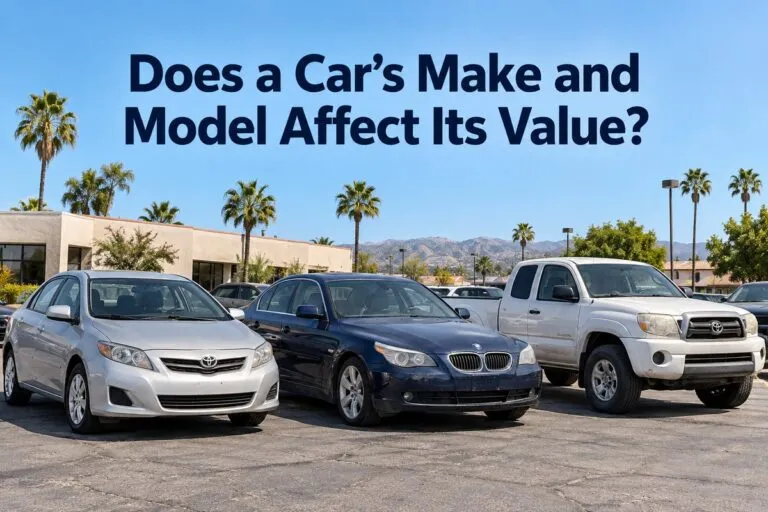
A car’s make and model affect its value by influencing buyer demand, expected repair costs, depreciation, and the potential value of its parts. Whether you’re selling a reliable daily driver or a junk car that no longer runs, the specific vehicle you own helps determine how much a buyer may offer.
For Southern California car owners, understanding these differences helps set realistic expectations. A popular compact car, a luxury sedan, and an older pickup can have very different values, even when their age and mileage are similar.
How Make and Model Influence Used Car Value
Buyers consider more than a vehicle’s appearance and odometer reading. They also consider what that particular model will cost to own, how well it fits their needs, and whether comparable vehicles are readily available.
Reliability and Expected Ownership Costs
A model with a reputation for dependable service can attract buyers who want to avoid expensive repairs. That appeal can support resale value, especially when the seller has maintenance records showing consistent care.
However, a brand name alone does not establish reliability. Different model years, engines, and transmissions can have different maintenance needs. Two cars from the same manufacturer may attract different offers because buyers anticipate different ownership costs.
When evaluating your vehicle, consider:
- Its specific model year and engine.
- Documented maintenance and completed repairs.
- Existing mechanical problems.
- Whether major components are approaching replacement.
- The availability and cost of replacement parts.
Buyer Demand and Available Inventory
Demand helps explain why similarly priced new cars can sell for very different amounts several years later.
A model that meets common transportation needs may appeal to a broad range of used car buyers. However, a large supply of similar vehicles can also give buyers more negotiating power.
Scarcity alone does not guarantee a higher price. A rare vehicle needs interested buyers to command a premium. An uncommon model with limited demand may be harder to sell than a familiar vehicle with plenty of competition.
Data Shows How Much Resale Value Varies by Model
The differences between models can be substantial. In its 2026 depreciation study, iSeeCars analyzed more than 950,000 five-year-old used vehicles sold from March 2025 through February 2026. Average depreciation across the study was 41.8%.
The selected examples below show how individual models compared.
| Vehicle | Average depreciation after five years |
|---|---|
| Toyota Tacoma | 19.9% |
| Honda Civic | 22.9% |
| Toyota Corolla | 27.6% |
| Honda CR-V | 28.9% |
| Honda Accord | 30.5% |
| Toyota Prius | 32.1% |
| Overall study average | 41.8% |
Source: iSeeCars five-year depreciation study. These are national study averages, not individual appraisals or junk car offers.
The takeaway is that a universal depreciation percentage cannot accurately value every car. Model-specific comparisons provide a better starting point, followed by adjustments for mileage, condition, equipment, and location.
Percentage Retained Is Different From Dollars Received
A vehicle that holds a larger percentage of its original price does not necessarily sell for more money.
For example, a hypothetical $25,000 car retaining 70% of its original price would be worth $17,500. A $50,000 vehicle retaining 50% would still be worth $25,000.
When selling, focus on the vehicle’s realistic current value. Its original sticker price and depreciation percentage provide context, but neither guarantees an offer.
Why Model Year, Trim, and Engine Change the Price
Knowing the make and model is only the beginning. Kelley Blue Book’s valuation process also considers details such as model year, mileage, ZIP code, trim, equipment, and condition.
Different Model Years Can Attract Different Offers
A redesign can change a vehicle’s engine, transmission, safety equipment, cabin, and fuel economy. Those differences may influence how buyers compare older and newer versions of the same model.
Mechanical history matters, too. If a particular version needs an expensive repair, buyers may reduce their offers to account for that expense and uncertainty.
Compare vehicles from the same generation whenever possible. A listing with the same model name may still represent a substantially different vehicle.
Trim Levels and Powertrains Need Accurate Comparisons
Equipment can affect used car value, but sellers should not expect to recover the full original cost of every upgrade.
Useful comparison details include:
- Trim level: Base, midrange, luxury, and performance versions can command different prices.
- Engine: Different engines may change operating costs, performance, and buyer interest.
- Drivetrain: Two-wheel drive, all-wheel drive, and four-wheel drive serve different needs.
- Body configuration: Cab size and bed length can affect pickup comparisons.
- Hybrid or electric equipment: Battery condition and system operation deserve attention.
A premium trim with broken equipment may lose much of its advantage over a well-maintained base model. Features add the most value when buyers want them and they work properly.
Does Make and Model Affect Junk Car Value?
Yes. A car’s make and model can still influence its value after it stops running. The valuation shifts toward repair potential, reusable components, and recyclable material.
Junk car pricing can account for make, model, condition, weight, parts value, and scrap market conditions. That means two non-running vehicles do not automatically deserve the same offer.
Repair Potential Can Preserve Value
A non-running car is not always ready for recycling. A buyer may see an opportunity to repair and resell it, depending on the problem and the model’s resale potential.
Consider two hypothetical vehicles with the same repair bill. If one would have a much higher resale value after repair, a buyer may have more room to offer money for it.
The diagnosis matters. “Doesn’t start” could describe a relatively minor issue or a major mechanical failure. Providing an existing diagnostic report can help a buyer assess the vehicle more accurately.
Usable Parts Can Influence an Offer
A damaged car may still contain components that other owners need. Their potential value depends on condition, compatibility, and demand.
Examples include:
- An operational engine or transmission.
- Undamaged doors, body panels, or lights.
- Factory wheels in usable condition.
- Interior components and electronics.
- Usable hybrid or electric vehicle components.
However, advertised retail prices for individual parts do not add up to the amount a buyer can pay for the complete car. Removal, testing, storage, shipping, and unsold inventory all affect the economics.
Scrap Value Makes the Badge Less Important
When a vehicle has little repair or parts potential, recoverable material becomes more significant. At that point, a luxury badge may add little to its value.
Vehicle weight can influence a scrap-based offer, but weight alone does not determine payment. Material composition, missing components, transportation costs, and local recycling conditions also matter.
A larger vehicle may contain more recyclable material, while a smaller vehicle may have more desirable usable parts. An individual assessment is more useful than assuming one category always pays more.
When Condition Matters More Than Brand Reputation
A desirable make and model cannot fully compensate for serious damage or neglect.
A maintained vehicle from a less sought-after brand may receive a stronger offer than a more popular model with major engine problems. The same principle applies when accident damage, missing components, or extensive deterioration change what a buyer can do with the car.
For sellers, this means describing the vehicle accurately:
- Does it start, run, and move under its own power?
- Are there warning lights or known mechanical problems?
- Is there collision, flood, or fire damage?
- Are major components missing?
- What maintenance and repair records are available?
Avoid comparing a damaged car directly with a clean, fully operational example. The cost and risk of bringing the damaged vehicle to comparable condition can significantly affect its offer.
How Southern California Sellers Can Compare Their Model
National resale rankings provide context, but local comparisons help you understand the market where you plan to sell.
For a Southern California vehicle, begin with nearby examples of the same year, model, trim, and powertrain. Expand the search only when there are too few close matches.
A practical comparison process is:
- Identify the exact vehicle. Confirm the model year, trim, engine, and major equipment.
- Match mileage and condition. Separate clean running cars from damaged or non-running vehicles.
- Compare the same selling channel. Dealer asking prices and direct purchase offers represent different transactions.
- Treat listings as asking prices. They do not prove what buyers ultimately paid.
- Request vehicle-specific offers. This is especially useful when standard pricing guides cannot reflect substantial damage.
For junk cars, compare the amount you would actually receive after any disclosed pickup charges or deductions. Give each buyer the same vehicle details so the offers are easier to evaluate.
Should You Repair Your Model Before Selling?
The answer depends partly on how much that model could sell for after the work is completed.
As a hypothetical example, spending $2,000 on repairs to increase an offer by $1,200 leaves you $800 behind. Even a desirable model does not make every repair worthwhile.
Before authorizing major work, compare an as-is offer with a realistic repaired value and a written repair estimate. Allow for the possibility that additional problems could appear.
For an older or heavily damaged car, selling as-is may be practical when repairs would consume most of the potential increase in value.
Your car’s make and model help establish its market potential, while its exact specifications and condition determine how much of that potential remains. Comparing the right vehicles and requesting offers based on complete information gives you a clearer picture of what your car is worth.
At Sell My Car SoCal, we buy used and junk cars in Southern California. If you’re ready to sell, contact us with your vehicle’s year, make, model, mileage, and condition to discuss your car.