
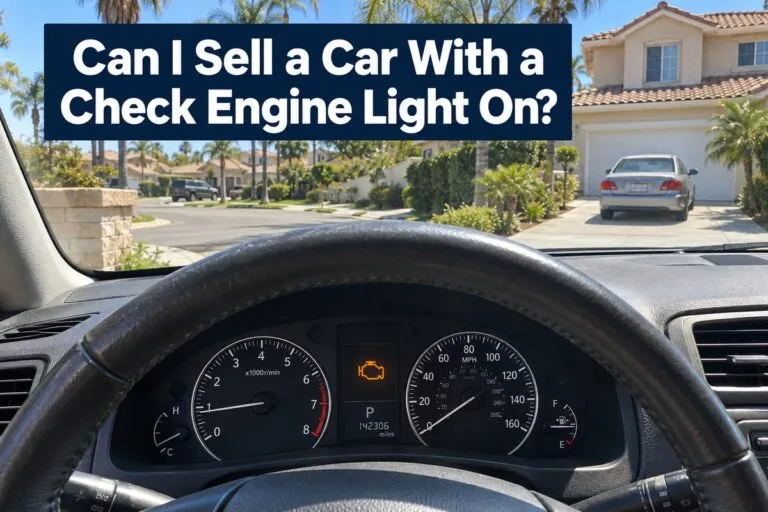
You can sell a car with a check engine light on, but in Southern California, the buyer you choose and the applicable smog requirements affect how you complete the sale. A warning light does not automatically make your vehicle worthless. However, it can limit your selling options and influence the price buyers offer.
If you want to sell a used or junk car without spending money on uncertain repairs, start by understanding your options. Knowing when repairs are worthwhile, what to disclose, and how California handles emissions requirements can help you avoid unnecessary expenses.
Can You Sell a Car With a Check Engine Light On in California?
Yes, but selling to a private individual is different from selling to a licensed dealer or transferring a vehicle for legal dismantling.
California generally requires sellers to provide valid smog certification for vehicles subject to inspection. State law makes exceptions for sales to dealers and sales for the purpose of legally wrecking or dismantling a vehicle. That distinction matters when your car has an unresolved emissions problem.
Before accepting an offer, establish who is buying the vehicle and how the transaction will be handled. An advertisement saying “cash for cars” does not, by itself, establish the buyer’s licensing or the applicable exemption.
Selling to a Private Buyer
A private buyer may like your car and agree to handle repairs, but that agreement does not automatically remove your smog responsibilities.
For a typical private sale requiring a Smog Check, California’s Bureau of Automotive Repair says the vehicle must have passed within the previous 90 days. If the check engine light prevents it from passing, you need to address the problem or choose an appropriate alternative selling route.
This can make a private sale less practical when your vehicle needs expensive repairs or you want to avoid paying for additional diagnosis.
Selling to a Dealer or Junk Car Buyer
A licensed dealer may consider buying a vehicle with mechanical problems because it can evaluate repair costs and resale potential.
For a car headed for dismantling, usable components and recyclable materials may still have value. However, confirm the buyer’s identity, the purchase terms, and the required paperwork before handing over your vehicle.
Ask these questions:
- Are you purchasing as a licensed dealer or for legal dismantling?
- Can you buy the vehicle with its current warning light and smog status?
- Is pickup included, or will transportation reduce my payment?
- What documents do I need?
- Under what circumstances could the quoted offer change?
Will a Car Pass Smog With the Check Engine Light On?
An illuminated check engine light is a Smog Check failure issue. A car can start normally, idle smoothly, and still fail its emissions inspection because the onboard diagnostic system has detected a problem. BAR identifies illuminated check engine lights and incomplete readiness monitors among reasons vehicles fail inspection.
For sellers, this means “it runs fine” is not enough to establish that a car is ready for a private sale requiring smog certification.
Turning Off the Light Does Not Prove the Car Is Fixed
Disconnecting the battery or clearing diagnostic codes can leave the vehicle’s readiness monitors incomplete. These self-checks need to run again before the vehicle can satisfy the applicable inspection requirements.
Some vehicles also store permanent diagnostic trouble codes. These cannot simply be erased with a scan tool or battery disconnect. The underlying fault must be repaired, and the vehicle must run the appropriate diagnostic monitor to verify the repair.
Avoid clearing codes to make the dashboard look better before an inspection or sale. Preserve the diagnostic information so a technician or buyer can evaluate the actual condition.
Should You Diagnose the Problem Before Selling?
A diagnosis can be useful if you are deciding whether a repair would increase your net proceeds. It can also help explain the vehicle’s condition to prospective buyers.
Start by asking for the diagnostic charge before authorizing work. Make clear that you want the fault identified and a written estimate before approving repairs.
Useful information to collect includes:
- The stored diagnostic trouble codes.
- The technician’s findings about the underlying cause.
- The proposed repair and total estimated cost.
- Whether further testing may be necessary.
- Whether the repair estimate includes follow-up verification.
A code scan and a completed diagnosis are not the same thing. Avoid advertising a problem as a “cheap sensor fix” unless a technician has confirmed that assessment.
If you already intend to sell the vehicle for dismantling, paying for extensive diagnosis may offer little benefit. Ask buyers whether diagnostic documentation would affect their offer before spending money.
How Much Does a Check Engine Light Reduce a Car’s Value?
There is no reliable flat deduction that applies to every vehicle. The effect depends on the car’s underlying condition and the uncertainty the buyer must accept.
A documented repair estimate gives a buyer something concrete to evaluate. An unexplained warning light leaves more questions about repair costs, additional faults, and whether the vehicle can pass inspection.
Buyers may consider:
- Vehicle details: Year, make, model, mileage, and trim.
- Operating condition: Whether it starts, drives, stalls, or overheats.
- Known repair needs: Confirmed faults and unresolved symptoms.
- Overall condition: Collision damage, interior wear, and missing components.
- Sale route: Resale, repair, parts recovery, or recycling.
- Transportation: Whether the vehicle requires pickup.
Compare Offers Based on the Amount You Keep
A higher headline offer is not always the better deal. Ask whether towing, processing charges, or other deductions apply.
Provide every buyer with the same information. Comparing one offer based on full disclosure with another based on incomplete details can create misleading expectations.
Also ask whether the quote is firm or subject to inspection. Get any conditions in writing.
Should You Repair the Car or Sell It As Is?
Compare the likely increase in sale proceeds with the complete cost of getting the vehicle ready to sell.
A repair may make sense when the problem is confirmed, the estimate is manageable, and the rest of the vehicle is in good condition. Selling in its current condition may be more practical when multiple repairs are needed or the repair outcome remains uncertain.
A Simple Repair-versus-Sale Example
Consider this hypothetical situation:
- Offer for the vehicle in its current condition: $2,000
- Expected selling price after repairs: $3,500
- Diagnosis, repairs, and inspection costs: $1,200
- Expected proceeds after those expenses: $2,300
In this example, repairing the vehicle produces only $300 more, assuming the repair succeeds and the car sells for the expected amount.
These figures are illustrative, not market estimates. Use actual offers and written repair quotes when comparing your options. Account for the time required to coordinate repairs, advertise the car, and meet buyers.
“As Is” Does Not Replace Required Smog Certification
An as-is description communicates that the vehicle has existing problems. It should not be treated as a workaround for California’s smog requirements.
Disclose the warning light and known defects, then use a selling route that meets the applicable requirements. Simply adding “buyer handles smog” to an advertisement does not create an exemption from the seller’s obligations.
What Should You Tell Buyers About the Warning Light?
Give buyers accurate observations and available documentation. You do not need to guess what is wrong.
Explain when the light appeared, whether it stays on or comes and goes, and whether the vehicle’s operation changed. Share any failed inspection report, diagnostic findings, or recent repair invoices.
For example, a useful description would be:
“The check engine light is on. The vehicle starts and runs, but the cause has not been diagnosed. The most recent Smog Check report is available.”
If repairs were attempted and the light returned, disclose that too. Clear information helps buyers evaluate the car and reduces the chance of disputes at pickup.
How to Prepare Your Car for Sale Without Unnecessary Repairs
Focus on accurate information and a complete handover.
Before requesting offers, gather:
- The vehicle identification number.
- The title and available registration documents.
- The current mileage.
- Details of any outstanding loan.
- Photos of the exterior, interior, and dashboard.
- Existing inspection reports and repair estimates.
Tell the buyer whether the car starts and whether it can move under its own power. If its condition makes driving questionable, arrange suitable transportation instead of assuming a test drive or delivery trip will be possible.
Remove personal belongings, garage remotes, and saved personal information from the vehicle before pickup.
Complete the Transfer and Release of Liability
Keep copies of the signed transaction documents and record the buyer’s information, sale date, price, and mileage.
California DMV requires sellers to submit a Notice of Transfer and Release of Liability within five days of selling a vehicle. Make this part of your sale checklist rather than leaving it for later.
You can sell a car with a check engine light on without automatically committing to expensive repairs. The key is to understand the car’s condition, compare realistic offers, disclose known problems, and choose a sale that satisfies California’s requirements.
At Sell My Car SoCal, we buy used and junk cars in Southern California. Contact us with your vehicle’s details and let us know about the check engine light, any failed smog inspection, and whether the car runs. Ask about selling it in its current condition before spending more money on repairs.