
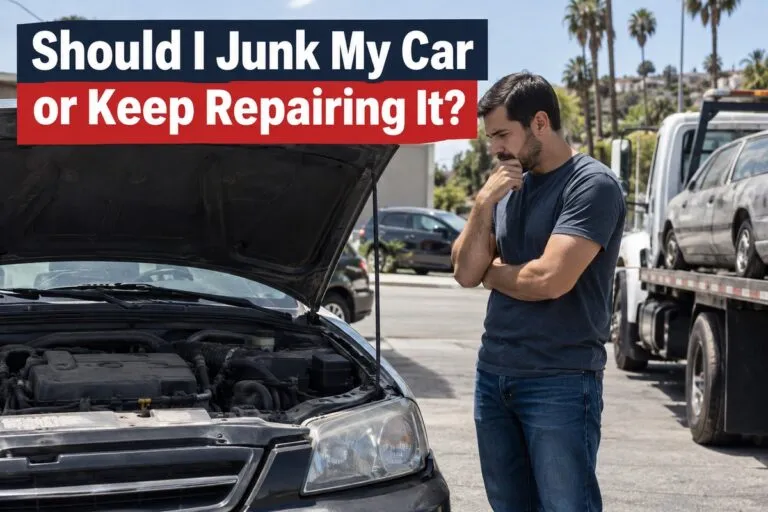
Should I junk my car or keep repairing it? This question usually comes up when repair bills start piling up, the car becomes less reliable, or another expensive problem appears shortly after the last one was fixed.
Keeping an older car can make financial sense when repairs are manageable and the vehicle remains dependable. But there comes a point when continuing to put money into a damaged, high-mileage, or unreliable vehicle may cost more than the car is worth.
If you are deciding whether to repair or junk a car in Southern California, the key is to look at the vehicle’s current value, repair costs, reliability, safety, and the likelihood of more problems appearing soon.
Compare the Repair Cost to Your Car’s Current Value
One of the best places to start is by comparing the estimated repair bill with what your car is actually worth in its current condition.
Suppose your vehicle might be worth $3,000 when running properly, but it needs $2,500 in engine repairs. Spending almost the entire value of the car on one repair can be difficult to justify, especially if the vehicle has other mechanical problems.
Do not base the decision only on what you originally paid for the car. That money has already been spent. Instead, focus on its current market value and what you would have to spend to keep it on the road.
Consider:
- The car’s current value in working condition
- Its value with the existing mechanical or body damage
- The cost of the immediate repair
- Other repairs that may be needed soon
- The vehicle’s mileage and overall condition
- How much you have already spent on recent repairs
A single inexpensive repair does not necessarily mean you should junk a car. A pattern of expensive repairs, however, can be a strong indication that selling the vehicle may make more financial sense.
Look Beyond the Current Repair Bill
The repair estimate sitting in front of you is only part of the decision. Older cars often develop several problems within a relatively short period.
You might replace a transmission only to need suspension work a few months later. An overheating issue could be followed by cooling system repairs, electrical problems, or another major mechanical failure.
Ask What Is Likely to Need Repair Next
Before approving an expensive repair, ask a trusted mechanic about the overall condition of the vehicle.
Find out whether there are signs of additional problems involving the:
- Engine
- Transmission
- Cooling system
- Suspension
- Steering
- Brakes
- Electrical system
- Air conditioning
- Emissions system
If the current repair is likely to give you several more years of dependable use, fixing the vehicle may be worthwhile. If the mechanic identifies several other costly issues, it may be time to consider selling or junking the car.
Consider How Often Your Car Is Breaking Down
An older car does not have to be perfect to be worth keeping. The bigger concern is whether it can still provide dependable transportation.
A vehicle that needs occasional maintenance is very different from one that constantly requires repairs.
If you regularly deal with warning lights, overheating, starting problems, fluid leaks, dead batteries, stalling, or unexpected breakdowns, the inconvenience can become just as important as the repair costs.
Frequent breakdowns can mean:
- Missing work or appointments
- Paying for towing
- Renting a vehicle or relying on rides
- Spending time at repair shops
- Dealing with unpredictable transportation
- Paying for one repair after another
When a car can no longer be trusted for everyday transportation, continuing to repair it may provide less value than selling it.
When Does It Make Sense to Keep Repairing a Car?
Not every high-mileage or older vehicle should be junked. In many situations, repairing a used car is still the less expensive choice.
The Repair Is Relatively Minor
Repairs such as a battery replacement, alternator, starter, brake service, or certain cooling system repairs may be reasonable if the rest of the vehicle is in good condition.
A repair bill can feel expensive without actually making the vehicle a junk car. The important question is what you receive in return for the money you spend.
If a $600 repair gives you another year or more of reliable transportation, for example, that may be a better financial decision than immediately replacing the vehicle.
The Engine and Transmission Are Still Strong
The engine and transmission are among the most important components to consider when deciding whether to keep an older car.
If both are operating properly and the vehicle has no serious structural or safety issues, repairing smaller problems can make sense.
The Car Has Been Reliable Overall
A well-maintained car with a good service history may still have plenty of useful life remaining, even with high mileage.
Mileage by itself should not determine whether you junk your car. A properly maintained vehicle with 180,000 miles may be a better candidate for repair than a neglected vehicle with substantially fewer miles.
Signs It May Be Time to Junk Your Car
There is no single rule that applies to every vehicle, but certain problems can make selling a junk car more practical than continuing to repair it.
Major Engine Failure
Engine replacement or extensive internal engine repairs can cost thousands of dollars.
If the vehicle is older, has high mileage, or already has other problems, putting a replacement engine into it may not provide enough value to justify the expense.
Transmission Failure
Transmission problems are another common reason owners decide to sell a damaged or non-running car.
A transmission rebuild or replacement can be expensive. Before approving the work, compare the repair estimate against the vehicle’s value and overall mechanical condition.
Severe Accident Damage
A damaged car does not always need to be repaired.
If your vehicle has significant collision damage, repairing the body, suspension, airbags, sensors, and other components can quickly become expensive. This is especially true for an older car with a relatively low resale value.
Selling the damaged vehicle as-is may be worth considering rather than paying for extensive repairs.
Serious Rust or Structural Damage
Surface rust may be manageable, but significant corrosion affecting structural areas is a different issue.
Structural damage can make repairs complicated and expensive. When major rust is combined with mechanical problems or high mileage, junking the vehicle may be the more practical option.
Multiple Expensive Problems at Once
One major repair might be manageable. Three or four major repairs can change the equation.
For example, a car that needs transmission work, new suspension components, air conditioning repairs, and emissions-related repairs may require more money than it is realistically worth.
Think About Your Car’s Mileage and Overall Condition
High mileage does not automatically make a vehicle a junk car, but it does increase the importance of looking at the vehicle as a whole.
As cars accumulate miles, major components naturally experience wear. If a high-mileage vehicle needs a costly repair, consider whether other original components may also be approaching the end of their useful life.
Look at the complete condition of the car, including:
- Mileage
- Maintenance history
- Engine condition
- Transmission condition
- Interior condition
- Body damage
- Tire condition
- Suspension wear
- Warning lights
- Fluid leaks
- Registration and emissions issues
The worse the overall condition becomes, the harder it may be to justify another major repair.
Factor in California Smog and Registration Issues
For Southern California car owners, mechanical repairs are not always the only expenses involved in keeping an older vehicle.
A car that cannot pass a required smog inspection may need additional diagnostic work and repairs before it can remain practical to operate and register.
If the vehicle already has major mechanical problems, adding emissions-related repairs to the total cost can make selling the car more attractive.
The important thing is to calculate the full amount required to get the vehicle back into usable condition rather than focusing on a single repair estimate.
Calculate What Another Year of Ownership Could Cost
Instead of asking only, “How much will this repair cost?” consider how much the vehicle may cost you over the next 12 months.
Add up reasonable estimates for:
- The current repair
- Upcoming maintenance
- Tires or brakes
- Known mechanical problems
- Registration-related expenses
- Possible towing costs
- Other repairs your mechanic expects soon
Then compare that amount with the value and usefulness you expect to get from keeping the vehicle.
This can provide a much clearer picture than looking at one repair bill in isolation.
Do Not Keep Repairing a Car Just Because You Already Spent Money on It
It is easy to think, “I’ve already put so much money into this car that I can’t sell it now.”
That can lead to spending even more.
Money spent on previous repairs should not automatically determine your next decision. What matters is the car’s condition today and how much additional money it will take to keep it reliable.
For example, spending $3,000 on repairs over the past two years does not necessarily mean you should approve another $2,500 repair. Ask whether spending that additional $2,500 makes financial sense based on the car’s current condition.
Get a Repair Estimate Before Deciding to Junk the Car
Even if you suspect the vehicle is no longer worth repairing, getting a professional diagnosis can help you make a more informed decision.
Ask for a written estimate whenever possible. You want to know what has failed, what needs immediate attention, and what other problems the mechanic sees.
Questions to Ask Your Mechanic
Useful questions include:
- Is this repair necessary to safely drive the car?
- Are there other major problems?
- How long should the repair reasonably last?
- Is the engine in good overall condition?
- Is the transmission in good condition?
- Are additional expensive repairs likely soon?
- Would you consider this car reliable after the repair?
The goal is not simply to find out whether the car can be fixed. Most vehicles can be repaired with enough money. The question is whether repairing it makes financial sense.
Compare the Cost of Repairing the Car With Selling It As-Is
Before spending thousands of dollars on repairs, find out what you could receive for the vehicle in its current condition.
Used and junk car buyers may purchase vehicles with mechanical problems, accident damage, high mileage, failed engines, bad transmissions, or other issues.
Getting an offer for the car as-is gives you another number to compare against the repair estimate.
For example, imagine you have a non-running car that needs $3,500 in repairs. If you can sell the car as-is and put that money toward another vehicle, that option may be more appealing than investing thousands into an aging car.
When Selling a Junk Car Can Make More Sense
Selling your junk car may be worth considering when the cost, reliability, and condition of the vehicle all point in the same direction.
It may be time to sell if:
- Repair costs are close to or higher than the car’s value
- The engine has failed
- The transmission needs replacement
- The car has major accident damage
- The vehicle has several expensive mechanical problems
- It frequently breaks down
- You no longer trust it for daily transportation
- The car has been sitting and is not worth restoring
- Repairing it would require money you would rather put toward another vehicle
Selling a junk car as-is can also eliminate the uncertainty of paying for a major repair only to discover another problem shortly afterward.
What If My Car Still Runs?
A car does not have to be completely dead before you consider selling it.
Many vehicles sold to used and junk car buyers still start and drive. Owners may choose to sell because the car needs too many repairs, has high mileage, has body damage, or is becoming unreliable.
If your vehicle still runs but you are facing an expensive repair, this can actually be a good time to compare your options.
You can estimate the cost of keeping it, determine its current as-is value, and decide which option makes the most financial sense before the vehicle suffers another major failure.
What If My Car Does Not Run?
A non-running vehicle can still have value.
Cars with blown engines, bad transmissions, electrical failures, collision damage, and other major problems may still be purchased based on their condition, parts, scrap value, make, model, year, and other factors.
If you have a non-running car sitting in a driveway, garage, parking space, or storage area in Southern California, consider what it would cost to repair compared with what you could receive by selling it as-is.
Paying for repeated diagnostics, towing, storage, and repairs can quickly reduce the benefit of keeping a vehicle you are unlikely to drive again.
Should You Repair the Car Before Selling It?
Not necessarily.
One mistake car owners can make is assuming they need to fix every problem before selling a used or junk vehicle.
Some repairs may increase the car’s selling price, but that does not mean you will recover everything you spend.
If you pay $2,000 to repair a vehicle and its sale value increases by only $800, you have spent more than the repair added to the car’s value.
Before fixing a vehicle specifically to sell it, compare:
- The expected selling price as-is
- The total repair cost
- The expected selling price after repairs
- The time required to complete the repairs
- The possibility of discovering additional problems
For cars with major mechanical issues, selling as-is may be simpler and more economical.
How to Make the Repair-or-Junk Decision
If you are still unsure whether to junk your car or keep repairing it, look at the decision from several angles instead of relying on one number.
Start with the repair estimate and the vehicle’s current value. Then consider its mileage, reliability, overall condition, upcoming repairs, and how much longer you realistically expect to keep driving it.
Keeping the car may make sense when the repair is affordable, the major components are in good condition, and the vehicle is otherwise dependable.
Selling or junking the car may make more sense when you are facing expensive repairs on a vehicle that already has high mileage, multiple mechanical issues, significant damage, or ongoing reliability problems.
If you are in Southern California and have decided that another repair bill is not worth it, Sell My Car SoCal buys used cars, junk cars, damaged vehicles, and non-running cars. Getting an offer for your vehicle as-is can help you compare what the car is worth today against what you would have to spend to keep repairing it.
The best decision is the one that makes sense based on the numbers. Before putting more money into an aging or damaged vehicle, calculate the real cost of keeping it and compare that with the option of selling the car in its current condition.
Content reviewed and published by Sell My Car SoCal Editorial Team .